
Exercises for osteochondrosis
|
The spine has four sections — cervical, thoracic, lumbar, and sacral. Each of these sections requires movements that are strictly specific to that section. |
|||||||||
Lumbar section.
 The lumbar
section bears the most load. The joints of the lumbar spine
receive nearly the full range of motion throughout the day — bending forward,
sideways, torso rotation, and axial loading — carrying the body
and heavy objects. Only one direction of movement is missing — longitudinal
stretching. This gap needs to be filled. Hanging from a horizontal bar
is not effective enough, as gripping the bar tenses the abdominal
and back muscles, holding the pelvis and preventing significant stretching.
Moreover, not everyone has a pull-up bar.
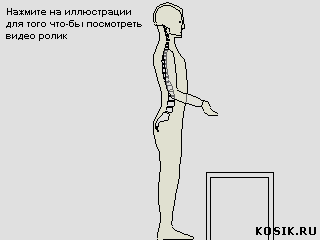
Much more effective is hanging with arm support (Figure 1). It
can be performed on any sturdy object (table, chair, windowsill,
etc.). Throughout the day, you should aim for at least four sets
of 10–15 seconds. This is quite sufficient to compensate for the axial
load a person experiences during the day. The lumbar
section bears the most load. The joints of the lumbar spine
receive nearly the full range of motion throughout the day — bending forward,
sideways, torso rotation, and axial loading — carrying the body
and heavy objects. Only one direction of movement is missing — longitudinal
stretching. This gap needs to be filled. Hanging from a horizontal bar
is not effective enough, as gripping the bar tenses the abdominal
and back muscles, holding the pelvis and preventing significant stretching.
Moreover, not everyone has a pull-up bar.
Much more effective is hanging with arm support (Figure 1). It
can be performed on any sturdy object (table, chair, windowsill,
etc.). Throughout the day, you should aim for at least four sets
of 10–15 seconds. This is quite sufficient to compensate for the axial
load a person experiences during the day.
 The mobility
of the thoracic section is limited by the ribs. Therefore, it participates
less in the range of motion but bears an enormous forward flexion load
(in a seated position). This itself is not a problem —
this is its purpose, and it handles it well. The problem arises
when this load becomes constant, and the thoracic section
develops a persistent flexion deformity over the years. Therefore,
it needs to be systematically extended — and not in general, but each
specific pair of vertebrae. The most effective and simplest method
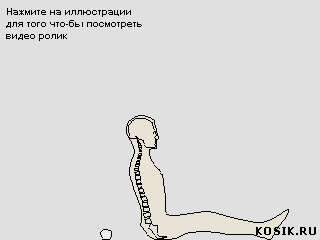
is nightly placement on the Kosik reclinator. The reclinator
is an elastic-amorphous ball the diameter of the patient's fist.
It can be made from an elastic medical bandage wound
into a ball. Place the reclinator on the floor, lie on it with your spine,
and try to relax as much as possible for 10–15 seconds. This extends
the intervertebral joints. Start with the interscapular area (15–30 seconds).
Then move up a couple of vertebrae, then down, covering
four to six locations. (Figure 2). The mobility
of the thoracic section is limited by the ribs. Therefore, it participates
less in the range of motion but bears an enormous forward flexion load
(in a seated position). This itself is not a problem —
this is its purpose, and it handles it well. The problem arises
when this load becomes constant, and the thoracic section
develops a persistent flexion deformity over the years. Therefore,
it needs to be systematically extended — and not in general, but each
specific pair of vertebrae. The most effective and simplest method
is nightly placement on the Kosik reclinator. The reclinator
is an elastic-amorphous ball the diameter of the patient's fist.
It can be made from an elastic medical bandage wound
into a ball. Place the reclinator on the floor, lie on it with your spine,
and try to relax as much as possible for 10–15 seconds. This extends
the intervertebral joints. Start with the interscapular area (15–30 seconds).
Then move up a couple of vertebrae, then down, covering
four to six locations. (Figure 2).
|
|||||||||
|
Exercise I. Exercise II. Exercise III. Exercise IV. |
|||||||||
|
Dr. Kosik's "Three S" Principle
|